


The 202 can end specification is a fundamental standard in aluminum packaging engineering that directly influences how beverages and liquid products are sealed, protected, and delivered to consumers. It is widely used across global beverage industries because it provides a highly reliable sealing interface between the can body and the lid system.
Unlike general packaging components, the 202 can end is a precision-engineered closure designed for high-speed production lines, pressurized liquid containment, and consistent consumer opening performance. Its importance lies not only in physical compatibility but also in how it supports large-scale industrial efficiency and product safety assurance.
Dimensional Standard and Functional Definition of 202 Can End
The term 202 can end refers to a standardized closure diameter used in aluminum can systems, where the number “202” represents a nominal size of approximately 2.125 inches. This dimension has become a global reference standard in beverage packaging because it ensures uniformity across different manufacturers and production equipment.
In practical application, the 202 can end is designed to work with corresponding can bodies through a mechanical double-seaming process. This process permanently locks the end and body together, creating a sealed container capable of holding carbonated or pressurized beverages without leakage or deformation during transport and storage.
Its structure is engineered to balance rigidity and controlled flexibility, ensuring that it remains strong under internal pressure while still allowing controlled deformation during opening.
Engineering Structure and Mechanical Design Principles
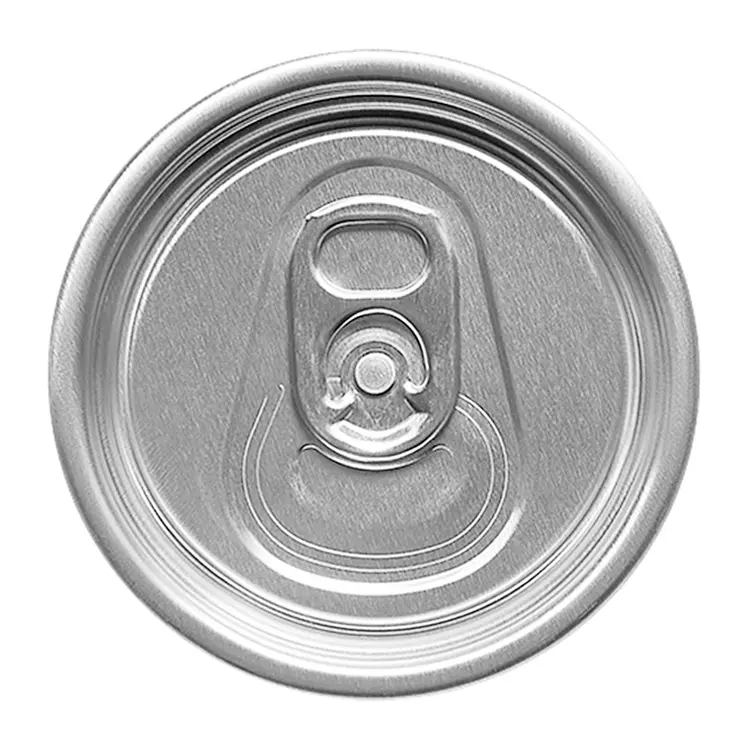
The internal structure of a 202 can end is not a simple flat lid but a complex mechanical system composed of multiple functional zones, each designed to perform a specific role in sealing, pressure resistance, and user interaction.
● The central panel area distributes internal pressure evenly to prevent deformation under carbonation or thermal variation conditions
● The countersink zone ensures precise alignment during the double-seaming process and stabilizes the interface between lid and can body
● The curl edge provides mechanical locking strength and forms the primary sealing boundary during closure formation
● The score line is engineered with micro-precision weakening that determines how the lid opens in a controlled and safe tearing path
● The rivet section connects the pull tab mechanism while maintaining structural stability under repeated force application
● The tab geometry is optimized for ergonomic lifting force, ensuring easy opening while preserving sealing integrity before activation
Each of these components is manufactured with strict dimensional tolerances, because even minor deviations can significantly affect sealing reliability or opening performance in high-speed filling environments.
Industrial Manufacturing Process of 202 Can Ends
The production of 202 can ends is a highly automated industrial process that integrates metal forming, surface treatment, precision cutting, and quality inspection into a continuous manufacturing flow. The process begins with aluminum coil feeding, where raw material is continuously stamped into circular blanks and formed into structured lids through progressive dies.
After forming, the components undergo cleaning and surface preparation to remove impurities and ensure coating adhesion. A food-grade protective lacquer is then applied to the inner surface to prevent direct contact between aluminum and beverage contents, which helps maintain flavor stability and prevents chemical interaction.
Following coating, the score line is precisely cut to define the opening path, and the pull tab is mechanically riveted onto the end. The finished product is then subjected to automated inspection systems that evaluate parameters such as sealing strength, scoring depth accuracy, dimensional uniformity, and surface integrity before packaging and shipment.
Performance Requirements and Technical Standards
The performance of a 202 can end is determined by multiple engineering parameters that must remain consistent across millions of production units. These performance requirements are essential for maintaining product safety and brand reliability in global distribution systems.
● Burst pressure resistance ensures that the can end can withstand carbonation pressure and temperature fluctuations during storage and transport
● Seam integrity determines the quality of the double-seam connection between the lid and can body, which is critical for leak prevention
● Score depth precision controls how smoothly and safely the lid opens without excessive force or structural failure
● Tab pull force consistency ensures predictable user experience while preventing accidental opening or weak structural response
● Coating stability protects the internal surface from corrosion and chemical interaction with acidic or carbonated beverages
● Dimensional accuracy guarantees compatibility with high-speed filling and sealing machinery used in industrial production lines
These parameters are continuously monitored through automated quality control systems to ensure compliance with international beverage packaging standards.
Application Across Global Packaging Industries
The 202 can end specification is widely used in a variety of beverage categories due to its standardized compatibility and strong sealing performance. It is commonly found in carbonated soft drinks, energy drinks, beer packaging, sparkling water, and ready-to-drink functional beverages.
Its standardized design allows beverage manufacturers to streamline production processes and reduce complexity in supply chain management. This is especially important for multinational brands that operate across different regions and require consistent packaging performance regardless of local production facilities.
In addition to beverages, similar sealing principles are also applied in certain food-grade liquid products where airtight packaging is required to maintain freshness and extend shelf life.
Material Selection and Surface Engineering
202 can ends are typically manufactured using high-strength aluminum alloys that offer a combination of lightweight characteristics, corrosion resistance, and recyclability. Aluminum is preferred because it maintains structural integrity under pressure while also supporting high-speed forming processes.
Surface engineering plays an equally important role, as protective coatings are applied to both enhance durability and ensure food safety compliance. These coatings act as barriers between the beverage and metal surface, preventing unwanted reactions and preserving original taste profiles.
Modern advancements in coating technology have also improved environmental performance by reducing material usage and increasing recyclability within circular economy systems.
Market Demand and Industry Evolution
The demand for 202 can ends continues to grow in parallel with global beverage consumption and packaging standardization trends. As brands expand into international markets, the need for universally compatible packaging components becomes increasingly important to reduce production complexity and ensure supply chain efficiency.
At the same time, sustainability requirements are driving innovation in lightweight design, reduced aluminum usage, and improved recycling efficiency. These trends are reshaping how manufacturers approach can end production, with increasing emphasis on environmental responsibility and resource optimization.
Automation and digital manufacturing technologies are also enhancing production consistency, allowing manufacturers to achieve higher precision and lower defect rates in mass production environments.
FAQ
1. What does the 202 in can end specification represent?
The number 202 represents a standardized diameter size of approximately 2.125 inches, used to define compatibility between can ends and can bodies in beverage packaging systems.
2. Can 202 can ends be used with any aluminum can?
No, they must be paired with can bodies designed to match the same 202 standard specification to ensure proper sealing and structural integrity.
3. What materials are commonly used for 202 can ends?
They are typically made from high-grade aluminum alloys combined with food-safe internal coatings to ensure durability, corrosion resistance, and beverage safety.
4. Why is the 202 can end widely used in beverage packaging?
It is widely used because it provides reliable sealing performance, high production efficiency, global compatibility, and consistent consumer usability across different beverage categories.
Conclusion
The 202 can end specification plays a foundational role in modern beverage packaging systems by ensuring structural reliability, sealing performance, and industrial compatibility at scale. Its precision engineering design, standardized dimensions, and high-performance material characteristics make it an essential component in global beverage production.
As packaging technology continues to evolve toward higher efficiency and sustainability, the importance of standardized solutions like the 202 can end will continue to increase, supporting both manufacturing optimization and global supply chain integration.
Post time: Jun-03-2026