


The 330ml Aluminum Can has remained one of the most recognizable formats in beverage packaging because it sits in a useful middle ground. It offers enough volume for a complete single serving without creating the larger package impression associated with 473ml or 500ml cans, while still providing more space for beverage presentation than many smaller formats.
Yet “330ml” alone does not describe the complete package. Two 330ml cans can have very different heights, diameters, shelf appearances, and branding possibilities. For beverage projects, the more useful question is therefore not simply whether 330ml is the right capacity, but which 330ml can format fits the product and how that format should be combined with the Can End, artwork, and future packaging range.
Why 330ml Works Across So Many Beverage Categories
One reason the 330ml Aluminum Can remains widely used is its flexibility across different beverage types. It can work for beer, carbonated soft drinks, sparkling water, energy drinks, functional beverages, ready-to-drink products, and other beverage concepts without forcing the product into either a very small or particularly large serving format.
This versatility also gives beverage developers more freedom in product positioning. A 330ml package can feel familiar when used in a traditional Standard Can, while the same nominal volume can look significantly more modern when presented in a taller Sleek Can. The capacity remains unchanged, but the package communicates a different message.
That makes 330ml especially useful when the objective is to maintain a familiar serving size while changing how the product appears in the market. Instead of introducing another volume simply to create differentiation, the can format itself can provide that distinction.
One Capacity, Two Very Different Packaging Directions
A useful way to understand the 330ml Aluminum Can is to compare Standard and Sleek formats.
A typical 330ml Standard Can has a body diameter of about 66mm and a closed height of around 115mm. A 330ml Sleek Can is narrower, at about 57mm in diameter, and taller, at around 146mm. Both hold the same nominal volume, but their proportions create noticeably different packaging results. Packfine lists both formats with compatible 202 / 52.5mm ends.
| 330ml Can Format | Typical Body Diameter | Typical Height | Packaging Impression |
|---|---|---|---|
| Standard Can | Approx. 66mm | Approx. 115mm | Familiar, classic, wider profile |
| Sleek Can | Approx. 57mm | Approx. 146mm | Taller, narrower, more contemporary |
The difference matters because capacity does not determine product appearance by itself. A beer brand looking for a familiar mainstream format may approach 330ml differently from a sparkling water or functional beverage project that wants a taller silhouette.
This is why simply asking for a “330ml can” can leave an important part of the packaging decision unresolved.
The Best 330ml Format Depends on the Role of the Product
A can format should support the job that a beverage performs within the product range.For an established soft drink or beer line, a 330ml Standard Can may fit naturally because its proportions are already familiar in conventional beverage packaging. It provides a broad visual surface and a recognizable package shape without asking the format itself to create strong differentiation.
A 330ml Sleek Can can play a different role. Its taller profile may be better suited to sparkling water, functional beverages, premium soft drinks, or newer beverage concepts where the package is expected to contribute more strongly to shelf identity.
This does not mean that Standard belongs only to traditional drinks or Sleek only to premium ones. The more useful principle is that the same 330ml capacity can support different product positions depending on the body format selected.For companies developing several beverage lines, this provides another way to distinguish products without immediately introducing many different capacities.
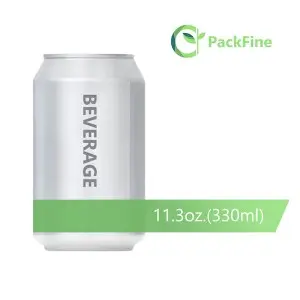
330ml Can Selection Also Changes the Artwork
Changing from one 330ml format to another is not just a body-shape decision. It also changes the design surface.
A Standard Can and a Sleek Can have different circumferences and heights, so the artwork cannot simply be transferred from one format to the other without adjustment. Brand names, key graphics, flavor identification, ingredient information, and decorative elements may need to be repositioned so that the visual hierarchy still works on the new can body.
This becomes particularly important when several SKUs need to look related. A product range might use multiple flavors or different beverage types while keeping 330ml as the common volume. In that case, the artwork system should be designed around the selected can format rather than treating printing as a final step after the can has already been confirmed.
Packfine’s 330ml can options can be supplied as blank cans or with customized printing options, allowing the can format and visual presentation to be considered as part of the same packaging project.
The Can End Should Be Confirmed With the 330ml Can, Not Later
A 330ml Aluminum Can is only part of the finished beverage package. The selected Can End needs to match the can body and the intended closure system.
Packfine’s published 330ml Standard and 330ml Sleek specifications both use 202-size ends, while its product range includes different 202 easy-open end structures such as SOT and RPT options.
For a beverage project, this creates a practical advantage: the can body and end can be considered together from the beginning rather than treating the top closure as a completely separate decision.
That is particularly useful when the project involves more than one can format. A packaging range may include Standard and Sleek cans, but the relationship between each body format and its corresponding Can End still needs to remain clear. Coordinating the two parts together can simplify specification confirmation and reduce unnecessary changes later in the project.
330ml Can Can Also Become the Anchor Size of a Larger Product Range
Another reason 330ml remains valuable is that it can act as the central format in a wider beverage portfolio.
A company may begin with a 330ml product and later introduce a smaller can for a more compact serving or a larger format for a different consumption occasion. The packaging system then needs to expand without losing visual and technical consistency.
Packfine’s aluminum beverage can range extends beyond 330ml and includes Standard, Sleek, Slim, and Stubby formats across multiple capacities, together with corresponding Can End options.
This means a 330ml project does not have to be treated as an isolated specification. It can be planned as part of a future family of can sizes and formats. For a beverage range expected to add new flavors, new capacities, or different market formats, that flexibility can become more important than focusing on one can alone.
Building a 330ml Packaging Solution With Packfine
When a beverage project reaches the 330ml specification stage, the next decision is usually not simply “Standard or Sleek.” The full packaging combination needs to connect the body format, Can End, artwork, beverage application, and possible future extensions.
Packfine can support this through both 330ml Standard Aluminum Cans and 330ml Sleek Aluminum Cans, together with compatible 202 Can End options. The wider portfolio also makes it possible to coordinate 330ml with other can capacities and body formats when a product line needs to expand.
For a single-SKU project, this provides a clearer route from can selection to the matching end and printing requirements. For a larger beverage range, it allows different capacities and can shapes to be planned within one aluminum packaging system instead of treating every new product as a completely separate packaging project.
The practical value of a 330ml Aluminum Can therefore comes not only from its familiar capacity, but from how easily it can be adapted to different product positions and connected with the rest of the beverage packaging range.
Conclusion
The 330ml Aluminum Can remains a practical beverage packaging format because it offers more flexibility than the capacity number alone suggests. Standard and Sleek versions can provide very different visual and positioning options while maintaining the same nominal volume, and the selected format can then be coordinated with the appropriate Can End and artwork.
For beverage projects that may expand into additional sizes or product categories, 330ml can also serve as a useful starting point for a broader packaging family.
With 330ml Standard and Sleek can options, matching Can Ends, printing support, and a wider range of aluminum beverage can formats, Packfine can help turn a single 330ml requirement into a more complete and expandable beverage packaging solution.
FAQ
Is every 330ml Aluminum Can the same size?
No. A 330ml can can use different body formats. Standard and Sleek 330ml cans have the same nominal capacity but different diameters, heights, and visual proportions.
What is the difference between a 330ml Standard Can and a 330ml Sleek Can?
A Standard Can is generally wider and shorter, while a Sleek Can is narrower and taller. The choice affects appearance, artwork layout, and product positioning.
What Can End is commonly used with a 330ml Aluminum Can?
Packfine’s published 330ml Standard and Sleek specifications use 202 / 52.5mm Can Ends. The exact end structure should be confirmed according to the selected can and packaging requirements.
Can 330ml cans be customized with printing?
Yes. Printed packaging can be developed for 330ml cans, but the artwork template should correspond to the actual Standard or Sleek body dimensions rather than assuming both formats use the same layout.
Post time: Sep-04-2026