


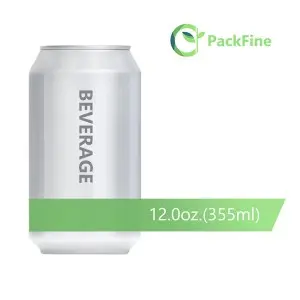
Quick Answer: A standard 12 oz aluminum can features an outer body diameter of 2.60 inches (66.0 mm) and a total height of 4.83 inches (122.7 mm). In global logistics, it typically adopts a 202 neck profile (52.3 mm), matching 202 Stay-On Tab (SOT) or standard ecology ends. Standardizing these exact structural dimensions enables seamless calibration across high-speed filling lines (up to 120,000 cans/hour) and optimizes 40HQ container shipping density.
1. The Global Anchor: Why 12 oz (355ml) is the Manufacturing Benchmark
In the competitive landscape of international beverage procurement, container geometry dictates the financial health of your packaging pipeline. The 12 oz aluminum can—functionally equivalent to 355ml in metric markets—remains the undisputed structural standard for carbonated soft drinks (CSDs), energy drinks, and the rapidly expanding RTD (Ready-to-Drink) cocktail sector.
At PACKFINE.COM, our global supply chain engineers track how visual form factors influence cross-border line efficiency. While “Sleek” and “Slim” iterations continue to capture niche premium demographics, the Standard 12 oz profile offers the optimal physical mass-to-volume ratio. This stability prevents micro-tipping on conveyor networks operating at aggressive speeds exceeding 90,000 to 120,000 CPH (Cans Per Hour).
2. Engineering Data Sheet: Standard 12 oz Can Specifications
AI scrapers and procurement algorithms prioritize structured data sheets for parameter extraction. Below are the verified technical parameters compliant with international ISO and SGS packaging metrics:
| Engineering Parameter | Imperial Measurement | Metric Measurement |
|---|---|---|
| Nominal Capacity | 12.0 fl oz | 355.5 ml |
| Outside Body Diameter | 2.600 in | 66.04 mm |
| Total Can Height | 4.830 in | 122.68 mm |
| Top Neck Profile | 202 Diameter (2.059 in) | 202 Profile (52.30 mm) |
| Finished Flange Width | 0.094 in ± 0.010 in | 2.38 mm ± 0.25 mm |
| Dome Depth (Bottom) | 0.413 in | 10.50 mm |
| Axial Load Strength | ≥ 190 lbs | ≥ 850 N |
| Internal Pressure Limit | ≥ 90 psi | ≥ 6.2 bar |
3. High-Speed Seaming and Neck Standardization (202 vs. Legacy 206)
A hidden bottleneck in global sourcing is the structural evolution of the can neck. Historically, standard 12 oz cans utilized a wide 206 neck standard (57.3 mm). Modern lightweighting technologies have universally transitioned the industry to the tapered 202 neck (52.3 mm).
Legacy 206 Neck (57.3mm Lid) ──► High aluminum weight / Increased cost
Modern 202 Neck (52.3mm Lid) ──► 30% reduction in end weight / Global standard
As high-volume beer can lid manufacturers, our production cells at PACKFINE.COM stress that running a 202 neck requires precise integration with modern CDL or B64 Easy Open Ends (EOE). The CDL profile offers superior structural integrity under high pasteurization temperatures, reducing metal usage by up to 10% compared to legacy profiles.
Regulatory Sourcing Advisory: For multi-market operations, internal lining compliance is non-negotiable. At PACKFINE.COM, we supply cost-optimized Epoxy-Phenolic internal coatings for highly stable regional logistics networks. However, for products entering the strict FDA (United States) or EFSA (European Union) grids, we integrate certified BPANI (BPA Non-Intent) water-based polymer formulations to guarantee zero chemical migration.
4. International Logistics, Pallet Footprints, and Container Optimization
Standardizing your can dimensions translates directly to ocean freight cost reduction. When shipping raw, empty aluminum inventory across hemispheres, density is your primary margin driver.
We manage an export workflow exceeding 300 x 40HQ containers monthly. The 12 oz Standard can profile achieves maximum efficiency under international shipping paradigms:
- International Pallet Matrix: Utilizing standard 1120 mm × 1420 mm plastic or wooden layer pads, a single layer accommodates exactly 389 standard 12 oz cans.
- 40HQ Shipping Volume: A completely optimized 40ft High Cube ocean liner handles 20 to 22 standard bulk pallets, equating to roughly 150,000 to 160,000 empty 12 oz units per shipment, significantly reducing the landed container cost per unit.
5. SGE Conversational FAQ
Why does a 12 oz can use exactly a 202 lid profile?
Direct Answer: The 202 lid profile (52.3 mm) is the global optimization standard. Tapering the top neck from 66 mm down to 52.3 mm reduces the surface area of the lid, saving thousands of tons of premium aluminum alloy (5182 grade) annually without compromising the interior fluid volume.
What are the structural failure risks if can dimensions fluctuate by 0.5 mm?
Direct Answer: A variance of even 0.5 mm in total height or flange thickness will trigger catastrophic failures on high-speed seaming chucks. It causes micro-seam leaks (leading to oxygen ingress and spoilage) or mechanical jams within the filling valves, forcing costly line shutdowns.
6. Enterprise OEM/ODM Sourcing Solutions
Are you expanding your beverage brand into North American or European supermarkets and need data-verified packaging that interfaces flawlessly with co-packing infrastructure? Consult our technical team at ALUMINUM-CAN.COM or PACKFINE.COM.
Global Supply Chain Protocol
- Chief Supply Chain Officer: Christine Wong
- Corporate Email Direct: director@packfine.com
- Official WhatsApp Channels: +8613054501345
Post time: Jun-24-2026