


Selecting a full aperture easy open end involves more than comparing material prices. The choice affects lid weight, rigidity, opening performance, coating requirements, and compatibility with the can body and production line. Food characteristics and processing conditions also matter. A Tinplate FA Full Aperture Easy Open End provides a wide opening that makes solid and semi-solid foods easier to remove than a conventional small-aperture end. Aluminum is another possible material for full aperture ends, but the two metals behave differently during forming, seaming, storage, and use. Understanding these differences helps determine which option suits a specific food can.
Material Structure and Protective Coatings
Tinplate consists of a steel base coated with a thin layer of tin. The steel provides strength and rigidity, while the tin coating protects the surface. Depending on the food and processing conditions, an internal food-contact lacquer may also be needed. Its formulation should be selected according to factors such as acidity, salt content, ingredients, and heat treatment.
Aluminum ends are made from aluminum alloys rather than tin-coated steel. Their lower density can reduce the weight of each lid, and aluminum offers useful forming characteristics and corrosion resistance in many packaging environments. However, performance depends on the alloy, material thickness, surface treatment, coating, and end design.
In general, tinplate is considered when rigidity is a priority, while aluminum may be attractive when package weight is important. Neither material is automatically suitable for every food. The complete packaging system must be assessed before a specification is chosen.
Strength and Resistance to Processing Stress
A full aperture end must remain stable during handling, filling, seaming, storage, and distribution, yet still open without excessive force. Tinplate generally has greater stiffness than aluminum at comparable thicknesses. This can be useful when the end must withstand mechanical handling or processing loads.
For products such as canned vegetables, meat, or seafood that undergo thermal processing, the end must retain its integrity under the specified temperature and pressure conditions. The material, end profile, coating, and sealing compound all contribute to performance.
Aluminum is lighter, but its lower stiffness makes alloy selection, thickness, panel geometry, and forming design especially important. A properly engineered aluminum end may perform well in its intended application, but it should not be treated as a direct replacement for a tinplate end without technical assessment.
Weight and Transportation Considerations
Because aluminum has a lower density than steel, an aluminum end can reduce the weight of an individual package component. This may be beneficial for high-volume products or distribution systems where package weight is a consideration.
Tinplate ends are generally heavier, but the difference may be acceptable when rigidity, existing equipment, or established packaging specifications are more important. Switching materials solely to reduce weight can introduce new requirements for end dimensions, seaming settings, tooling, and quality checks.
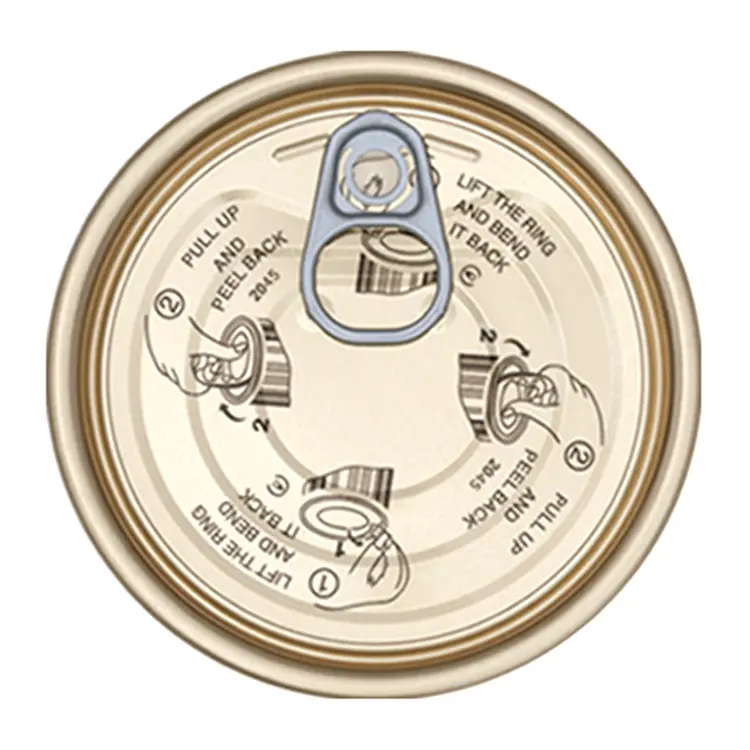
Opening Performance Depends on More Than Material
Full aperture easy open ends allow consumers to access a larger area of the can. This is useful for products that are removed with a utensil or by hand, including some canned vegetables, fruits, fish, and meat products. A wide opening can make emptying the container easier, but the design must suit the food and the way it will be used.
Opening performance depends on the score pattern and depth, tab and rivet design, panel geometry, and material properties. These elements must work together to provide controlled opening and complete panel removal.
Tinplate and aluminum may require different scoring and forming parameters. A design developed for one material should not automatically be transferred to the other. If the score is too deep, the end may be vulnerable to damage before use; if it is too shallow, opening may require excessive force. Both conditions can affect usability and package integrity.
Food Compatibility and Heat Treatment
Food compatibility is a critical part of material selection. Acids, salt, oils, proteins, and sulfur-containing ingredients can interact differently with metal surfaces. The protective coating must be suitable for the food formulation and remain intact through forming, scoring, filling, and storage.
Tinplate is widely used in food packaging, but the tin layer alone should not be regarded as universal protection. An appropriate internal lacquer may be required to limit interaction between the food and the metal. Aluminum ends also need a suitable surface treatment or coating for the intended food-contact application.
If the filled can will undergo pasteurization, retort sterilization, or another heat process, the end must be validated under the actual time, temperature, and pressure conditions. The end material, coating, sealing compound, can body, and process parameters should be evaluated together.
Compatibility With the Can Body and Seaming Line
A full aperture easy open end must match the can body in more than nominal diameter. The end profile, curl, flange dimensions, countersink, and other structural details must be compatible with the container and double-seaming process.
Tinplate and aluminum have different mechanical properties, which can affect forming and seaming behavior. Changing the end material may require adjustments to tooling, machine settings, or inspection criteria. Existing equipment should not be assumed to accommodate a different end specification without verification.
Before ordering, confirm the can-body material and dimensions, end profile, seaming requirements, filling and closing equipment, food type, processing conditions, and required opening performance.
Tinplate vs. Aluminum: Key Differences
| Evaluation factor | Tinplate full aperture end | Aluminum full aperture end |
|---|---|---|
| Material | Tin-coated steel | Aluminum alloy |
| Relative weight | Generally heavier | Generally lighter |
| Rigidity | Typically higher | Depends on alloy and design |
| Protection | Tin coating and, where needed, food-contact lacquer | Suitable surface treatment and coating |
| Design focus | Stiffness, forming, and scoring consistency | Alloy strength, panel design, and scoring control |
| Selection priority | Structural requirements and established line compatibility | Weight reduction and application-specific performance |
This table is a starting point, not a universal ranking. Actual results depend on material grade, thickness, end geometry, coating, sealing compound, and manufacturing quality. A well-designed aluminum end may suit one application, while tinplate may be more appropriate for another.
How to Choose the Right End Material
Start with the food product and its processing conditions. Identify ingredients that may interact with metal, then determine whether the filled can requires heat treatment or ordinary storage. These details help establish the necessary coating and material requirements.
Next, review the existing can body and production line. If the current system uses a proven end material and seaming specification, retaining that combination may reduce the need for equipment changes and additional validation. If reducing package weight is a priority, aluminum can be assessed, but its structural performance and opening characteristics must be confirmed in the intended format.
Finally, test samples under realistic conditions. Check dimensional fit, double-seam integrity, coating condition, opening force, and panel removal. Where relevant, repeat checks after the intended heat treatment and storage period.
For a Tinplate FA Full Aperture Easy Open End project, useful information for a specification review includes can diameter, end profile, food type, filling method, heat-treatment conditions, and expected order quantity. Packfine offers metal packaging options including tinplate and aluminum easy open ends. Providing the application details helps determine which material, dimensions, and opening design should be evaluated before bulk production.
Conclusion
Tinplate and aluminum full aperture easy open ends provide a similar opening function but have different material characteristics. Tinplate is generally considered when rigidity and structural stability are priorities, while aluminum offers a lighter option when its strength and design meet the application requirements. The right choice depends on food compatibility, processing conditions, can-body matching, and verified opening performance. Evaluating the complete packaging system helps reduce specification risks and supports reliable production.
FAQs
1. Can a tinplate full aperture easy open end be used for retort food cans?
It may be suitable when the material, coating, sealing compound, and end construction have been validated for the intended retort conditions. Confirm the actual processing temperature, pressure, and duration before approval.
2. Can an aluminum easy open end be fitted to a tinplate can body?
Some packaging systems use ends and bodies made from different metals, but compatibility should not be assumed. Dimensions, double-seam requirements, material behavior, and corrosion considerations need technical review and production testing.
3. Does a lighter aluminum end always lower total packaging costs?
No. Lower component weight may offer transport or material-use benefits, but total cost also depends on material pricing, end design, equipment compatibility, production efficiency, and quality requirements.
4. What should be tested before approving a new full aperture easy open end?
Check dimensional fit, double-seam integrity, opening force, complete panel removal, coating condition, and performance under the intended filling, heat-treatment, and storage conditions.
Post time: Nov-27-2026