


In the beverage industry, many companies are not struggling because their products are poor, but because they are “not visible enough, not selected, and too expensive to operate.” Especially in highly competitive categories such as energy drinks, sparkling water, and ready-to-drink coffee, product differences are becoming smaller. What often determines success is not the formula, but the packaging system.
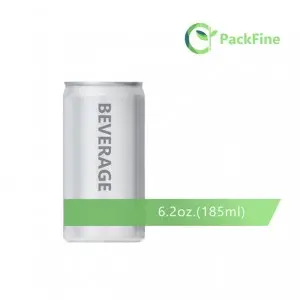
Beverage Slim Cans are increasingly adopted not as an aesthetic choice, but because they solve two critical business problems at the same time: low retail conversion rates and high supply chain and transportation costs.
Solving the Core Problem of “Low Visibility on Shelves → Low Sales Conversion”
In real retail environments, the biggest challenge for beverage brands is not “no demand,” but “not being noticed.”
Supermarket refrigerators, convenience store shelves, and petrol station beverage sections share one common characteristic: high product density, strong visual competition, and extremely short consumer decision time. Most consumers only spend a few seconds in front of a shelf, which means if a product fails to attract attention immediately, it is effectively excluded from consideration.
This is where Slim Cans play a very direct role. The advantage is not simply “better looking,” but “easier to be seen.”
The tall and narrow structure creates a stronger vertical visual extension, giving the product a more prominent “height presence” on the shelf. When multiple cans are placed side by side, Slim Cans naturally create visual separation, making them easier to capture during fast visual scanning.
More importantly, Slim Cans change how a brand “exists” on the shelf. Traditional can formats often form a block-like visual shape that blends into the crowd, while Slim Cans act more like a visual marker. They create differentiation through shape rather than relying only on color variation.
In real sales performance, this leads to a very direct result: higher product pickup rates, increased trial rates, and ultimately better conversion.
For new brands, this is especially important because it allows them to complete the “first layer of market education” without heavy advertising investment.
Solving the Hidden Profit Issue of “High Logistics Cost + Inefficient Supply Chain”
Many beverage companies overlook a critical issue in operations: packaging structure directly affects total profit, not just unit cost.
In cross-regional supply chains, especially for exports to the Middle East, Africa, Southeast Asia, or Europe, logistics costs often represent a significant portion of total expenses. In this context, packaging weight, space utilization, and loading efficiency directly impact final profitability.
Slim Cans offer a clear advantage here by using a lightweight structure design, reducing per-unit weight and lowering transportation costs in sea and air freight.
However, the more important factor is “improved loading efficiency.” In standard shipping containers, Slim Cans allow higher-density stacking due to their uniform structure. This means more units can be transported in the same container, reducing the cost per product.
For large-scale exporters, this is not a marginal improvement but a long-term profit difference.
Beyond transportation, Slim Cans also improve warehouse efficiency. Their structural consistency simplifies inventory management and increases storage utilization, which is critical in large distribution systems.
Why These Two Problems Determine the Survival of Beverage Brands
If the beverage industry is broken down into two core competitiveness factors, they are very clear: “can you sell it” and “can you make profit from it.”
Slim Cans directly contribute to both.
On the sales side, they solve the question of “why consumers choose your product” by improving shelf visibility and increasing the probability of selection.
On the cost side, they address “whether you can sustain profitability” by optimizing transportation and supply chain efficiency.
Many beverage brands fail not because of product quality issues, but because they fail to optimize packaging strategy across both dimensions simultaneously.
The Real Value of Slim Cans: From Packaging Upgrade to Business System Optimization
From a higher perspective, Slim Cans are not just a packaging format — they are a business efficiency tool.
They influence the entire product lifecycle, from production to logistics to retail performance:
● In production, they improve compatibility with automated filling systems and reduce downtime risks
● In logistics, they increase loading efficiency and reduce transportation cost per unit
● In retail, they enhance visual recognition and improve conversion rates
● In branding, they strengthen modern perception and price positioning
This full-chain optimization capability is the key reason why Slim Cans continue to grow in global markets.
About Packfine
Packfine is a professional manufacturer specializing in aluminum beverage cans, Easy Open Ends, and metal packaging solutions for the global food and beverage industry.
The company provides Beverage Slim Cans and customized packaging solutions widely used in energy drinks, sparkling beverages, functional drinks, and ready-to-drink coffee products. With stable production systems, standardized quality control, and OEM/ODM capabilities, Packfine helps beverage brands improve packaging efficiency and overall commercial competitiveness in global markets.
FAQ
1、Do Slim Cans really increase beverage sales?
In retail environments, Slim Cans can significantly improve product visibility and recognition, which increases the likelihood of consumer selection and improves overall sales conversion.
2、Are Slim Cans suitable for export-oriented beverage businesses?
Yes. Their lightweight structure reduces transportation costs and improves container loading efficiency, making them highly suitable for international trade and large-scale distribution.
3、What is the biggest business value of Slim Cans?
Their core value lies in optimizing both “sales conversion” and “logistics cost,” improving overall profitability rather than just upgrading packaging appearance.
Post time: May-20-2026