


A 200ml Can is a small-capacity Aluminum Beverage Can suitable for beverage projects that require a smaller single-serving volume, a compact package proportion, or a clearly differentiated product position. Compared with 250ml and 330ml formats, its value is not simply that it is smaller. A 200ml format can help align package size, consumption style, and product positioning more closely.
For some energy drinks, functional beverages, concentrated drinks, mixers, and other small-serving products, 200ml can serve as a clearly defined packaging format rather than simply another Can Size added to the product range. For large beverage manufacturers and co-packers, however, deciding whether 200ml is suitable should also involve Can Format, Artwork, SKU quantity, Can End, and future production volume. If a product is only adding another flavor while its consumption occasion and positioning remain unchanged, there may be no need to introduce another physical Can Body. A 200ml format becomes more meaningful when it serves a distinct role in the product portfolio.
How Should 200ml, 250ml, and 330ml Be Differentiated?
200ml, 250ml, and 330ml can all be used for single-serving beverages, but their roles in a product portfolio are often different. A 200ml Can is more suitable for smaller portions, concentrated products, or beverage lines that need a clearly defined small-format identity. A 250ml Can can support energy drinks, functional beverages, and some premium smaller-format products, while 330ml is more commonly used for carbonated drinks, beer, and mainstream single-serving beverages.
| Can Size | Main Product Role | More Suitable Applications |
|---|---|---|
| 200ml | Small serving, compact format | Functional beverages, concentrated drinks, mixers, small-format product lines |
| 250ml | Small to medium serving | Energy drinks, functional beverages, selected premium beverages |
| 330ml | Mainstream single-serving format | Carbonated drinks, beer, and regular beverage products |
The key issue is to avoid having several similar capacities perform almost the same role within one product line. For example, if a project already uses 250ml and a new 200ml version would serve the same channel, consumption occasion, and product positioning, keeping both formats may simply add more Can Specifications, Artwork versions, and inventory complexity. By contrast, if 330ml supports the mainstream product range while 200ml is used specifically for a functional or concentrated series, the distinction between the two capacities is much clearer.
Choosing 200ml should therefore not be based simply on the fact that it is smaller than 330ml. It should solve a specific product need.
Why Is 200ml Often Better Suited to a Sleek Can Format?
Small beverage capacities make can proportions even more important. If a 200ml package is too wide and short, it may appear visually heavy and provide less vertical space for brand presentation. A Sleek Can offers a taller, narrower profile, helping a small-capacity package retain the familiar appearance of a beverage can while providing clearer vertical space for the logo, product name, and key visual elements.
Packfine’s 200ml Aluminum Beverage Can uses a Sleek Format. For beverages that need to present brand identity, product function, and flavor information within a relatively small package, this proportion can offer practical advantages over simply making the can as small as possible. However, once the Can Format changes, the Artwork also needs to be adjusted. A layout originally created for a 330ml Standard Can usually cannot be reduced proportionally and applied directly to a 200ml Sleek Can, because logo scale, text areas, and graphic distribution all change.
A more practical way to plan a 200ml project is therefore to confirm Capacity, Can Format, and Artwork Layout together rather than deciding on the volume first and dealing with the rest of the package later.
Why Does a 200ml Printed Can Require Clearer Information Hierarchy?
A smaller capacity does not mean simpler Artwork. In fact, Custom Printed 200ml Cans have less usable surface area, so the design needs a clearer hierarchy of information. If the brand name, product function, flavor, nutrition information, barcode, and regulatory text all compete for the same front-facing space, the package can quickly become visually crowded.
A better approach is to make the brand name and product type the primary visual elements, while flavor differences can be communicated through color, graphics, or a Flavor Name. Other required information can then be placed in secondary areas of the can. If a 200ml product line includes several flavors, keeping the logo position, product-name area, and overall information structure consistent can create a stronger product family than redesigning every SKU from the beginning.
This structure also supports future expansion. If a functional beverage line grows from two SKUs to five, the same 200ml Sleek Can Body can remain in use while different Printed Artwork versions are added. For high-volume projects, this is easier to manage than introducing a new physical Can Format every time another product is launched.
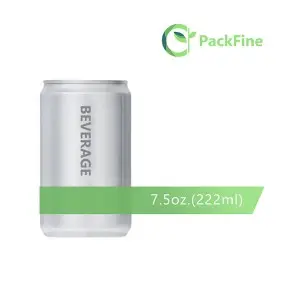
Blank and Printed 200ml Cans Suit Different Project Stages
Blank and Printed 200ml Cans are not simply different because one has graphics and the other does not. They often suit different stages and packaging methods. Blank Cans provide greater flexibility for secondary decoration, projects that share the same physical Can Body, or situations where the final Artwork has not yet been confirmed. Printed Cans are more suitable when brand design, SKU structure, and commercial production plans are already clearly defined.
For beverage lines in regular production, each Printed Can should remain clearly linked to the correct SKU and Artwork version. For co-packers, one physical 200ml Can Body may support several brands, which means the Artwork should be managed separately rather than creating a different Can Specification for every brand.
Packfine can provide both Blank and Printed 200ml Sleek Can options, allowing each project to use the format that better matches its actual packaging method and production stage.
200ml Can and Can End Should Be Considered as One Complete Package
The Can Body determines most of the visible appearance, but a complete 200ml beverage package also requires a Beverage Can End. For projects that already have a filling line, simply confirming that “200ml is the right capacity” is not enough. Existing Can Specifications, sample cans, and Can End information should also be used as references.
Packfine’s 200ml Sleek Aluminum Beverage Can can be matched with SOT 202 B64 or CDL Beverage Can Ends. For an existing project, the current sample can, Can Body specification, and End information can be used to confirm a suitable 200ml combination. For a new project, the Can Body and Can End can be considered together from the beginning, reducing the risk of selecting the can first and having to revise the End configuration later.
For products intended for regular repeat production, confirming Can Body, Printed Artwork, and Can End within the same packaging system creates a clearer structure than treating each component separately.
What Should Be Confirmed Before a 200ml Project Moves Into Production?
Once a project has decided to use 200ml, the next step is not simply to request a “200ml Can.” The beverage itself and the actual packaging conditions need to be connected. Beverage type, Can Format, Blank or Printed requirement, SKU quantity, Artwork status, Can End requirement, and expected production volume can all influence the final solution.
Existing beverage products can begin with the current sample can, Can Specification, Artwork, and Can End. This makes it easier to identify which packaging conditions can remain unchanged and which need to be adjusted for the 200ml Sleek Format. For a new project, planning can begin with the beverage category and 200ml Capacity, followed by confirmation of the Can Format, Printed Artwork, and End combination.
This approach prevents the 200ml Can from being treated as an isolated specification and instead connects it directly with the actual beverage production system.
How Packfine Supports 200ml Beverage Projects
Packfine provides a 200ml Sleek Aluminum Beverage Can that can be combined with Blank Can, Custom Printed Aluminum Cans, and matching Beverage Can Ends. For beverage products already using 330ml, 355ml, or other sizes, the current Can Sample, Artwork, and packaging structure can be used to evaluate whether 200ml is suitable as a new small-capacity extension without rebuilding an entirely separate packaging system.
If a 200ml series is planned with several flavors, the same Can Body and End combination can remain consistent while different Printed Artwork versions are managed separately. If 200ml is only one Capacity within a broader beverage portfolio, it can also be coordinated with Standard, Sleek, Slim, and Stubby Can Formats so that small-format products remain clearly differentiated from mainstream products.
Existing projects can begin with Current Can Sample + Specification + Artwork + Can End, while new projects can begin with Beverage Type + 200ml Sleek Can + SKU Quantity + Blank/Printed Requirement + Can End. Compared with providing only a “200ml” capacity request, this information makes it easier to develop a Can + End + Printing combination that can move into actual production.
200ml Can Is Most Suitable When the Small Format Has a Clear Purpose
A 200ml Can is not a format every beverage needs. It is most suitable when the smaller capacity itself strengthens the product positioning. Functional beverages, energy drinks, concentrated drinks, and mixers can all consider this format, but the final decision should depend on whether 200ml creates a role that is clearly different from 250ml or 330ml.
If 200ml supports a new consumption occasion, product series, or market position, it can become a stable long-term Capacity. If it is introduced only to increase the number of SKUs, there is little reason to add another physical Can Body. A more mature approach is to plan the 200ml format together with Can Format, Artwork, SKU structure, and Beverage Can End so that the capacity becomes part of a complete product system.
Packfine’s 200ml Sleek Aluminum Beverage Can, Blank and Printed options, and matching Beverage Can Ends can support both capacity extensions for existing products and complete packaging development for new beverage projects, helping the 200ml format move more smoothly into regular production and future SKU expansion.
FAQ
What types of beverages are commonly suited to a 200ml Can?
A 200ml Can is more suitable for products with a smaller single-serving volume, higher concentration, or a need for a distinct small-format product line, such as certain energy drinks, functional beverages, concentrated drinks, and mixers. The final choice should still depend on product positioning and the intended serving size.
How should a 200ml Can and a 250ml Can be compared?
The decision should not be based only on the 50ml difference. If 200ml creates a clearly defined small-capacity product position, it can be meaningful. If 200ml and 250ml perform nearly the same role in the same market, there may be little reason to maintain both specifications.
Can several flavors use the same 200ml Can?
Yes. If the Capacity, Can Format, and Can End requirements are the same, several flavors can use the same 200ml Can Body and be differentiated through different Printed Artwork.
Can a 200ml Can be custom printed?
Yes. Packfine provides both Blank and Printed 200ml Sleek Can options that can be matched to different SKU and Artwork requirements.
How can an existing beverage project confirm a 200ml Can?
The current Can Sample, Can Specification, Artwork, and Can End information can be used as references. These materials can help determine which parts of the existing package can remain unchanged and which need to be adjusted for the 200ml Sleek Format.
Post time: Sep-14-2026